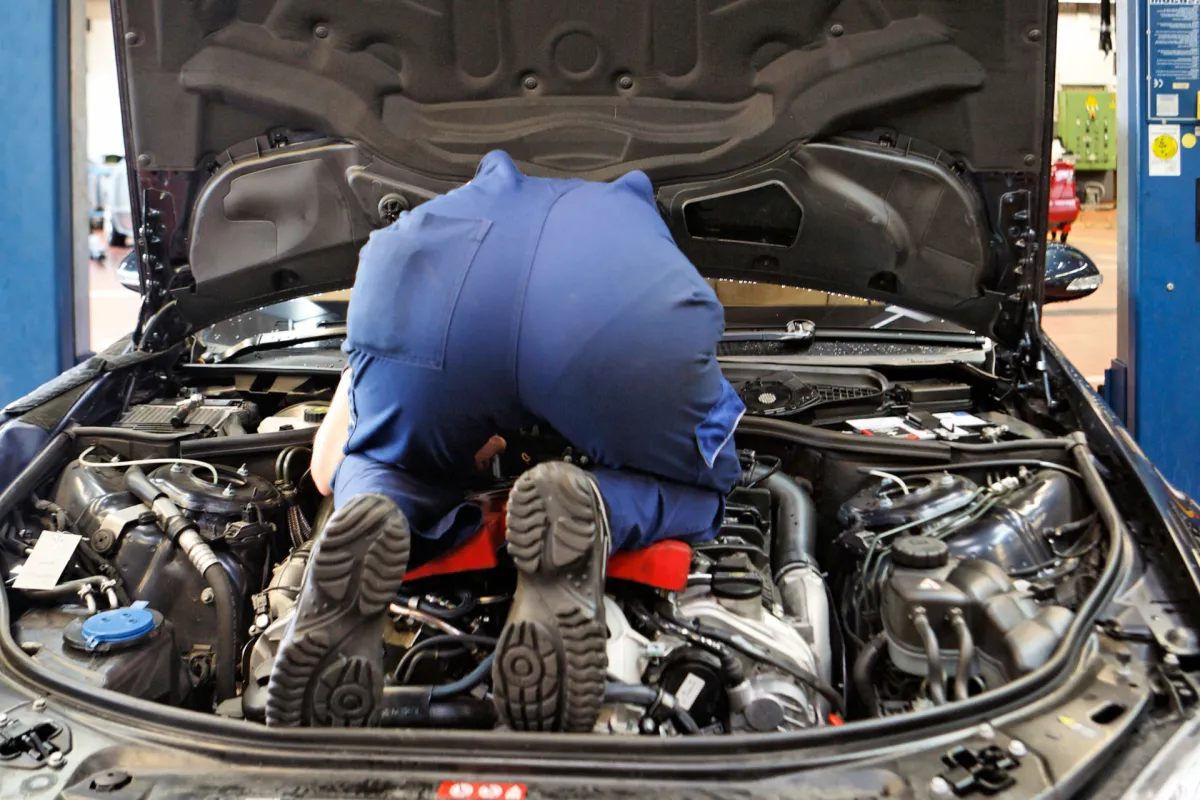
So the new reality in workshops today is just having a technically astute foreman isn't enough anymore, especially if you have a team of ten or more productive people. Even apart from the caliber of some of the people that we deal with, too much has changed generationally and culturally to get by on technical skills alone. Now this gap causes a variety of problems, but let me bottom line it for you by giving you the bad news and the really bad news. The bad news is you're paying for this. This is costing you even if you don't have a line item on your balance sheet to quantify it. And that doesn't even count the human cost, the stress, the pressure, the grind on you and your team. But the really bad news, the piece that keeps getting missed, is this gap is self perpetuating. That is, it keeps screwing with your time, screwing with your bottom line, causing all manner of unintended consequences until you address it directly. It never just goes away. So I do a lot of technical training, and I get the opportunity to have some really candid conversations with technicians in the breaks. And so while they're your technicians, you don't hear what I hear. Now that's both inspiring and heartbreaking at times, but the piece that I find fascinating is the patterns to the stories, patterns like Justin. Now Justin's a technician, so we can't show you his face. But Justin feels like he's not getting anywhere, and he's really frustrated about it. And when we unpack what's really going on, we discover a team of technicians that are being micromanaged to despair. Or patterns like Will. Will is the sort of tech that you poach, except that he just left the industry. And our discussion not long before he pulled the pin, was he just being nudged by management? We're going to start a new workshop. We want you to be foreman. What do you say? He had a good hard look at what his foreman was going through, and he tells me there is no way you could pay me enough money to do that. And, of course, without a future, why would you stay? Now the impact of his departure left a massive gap in the workshop capacity and, of course, the gross profit. And that's even without talking about the maxed out stress levels of everyone else who was left. And then there's the patterns to Chris's story. Chris is a foreman, been doing it for years, runs a great team, and punches well above his weight. But even he knows he's ticking all of the boxes for overwhelm and burnout and his frustration is that he's only got one option. When all of this stuff drops on his plate, the only thing he can do is go harder. And, of course, when he does, there's more stuff on the plate. Now if you've ever been running a workshop where you've had an unexpected foreman departure, you would know that for the business, that's devastating. Now just to be clear, these patterns, this disengagement, disenfranchisement, overwhelm, aren't problems with the people. These are all symptoms of the workshop foreman's capacity gap, and we haven't even spoken about you. Like most service managers, you got into the role because you were up for the challenge. A little bit daunting, but that's part of the excitement. And you also probably want to make a difference and have, and of course, very Okay with being paid more. And who isn't? The other thing that we find is that service managers discover that the role isn't quite what they expected and not always in a good way. And one of the pieces that's often unexpected is the ability to be able to see problems but not necessarily shift them. They just seem to be out of your reach. And if that's you, I appreciate how that feels because it's not all that dissimilar from my story. I'm a thirty five year automotive industry tragic, and I love it. I love the people. I love the trade. I love the technology. I love the problem solving, and I love the challenge. So I did my time as an apprentice, moved through aftermarket into the dealer world, worked just about every job there is in a service department, then moved into the manufacturer where I became the national training manager for a global top five brand. The gut punch for me was when I realized that we were just playing around the edges. We were ticking boxes. We weren't actually addressing the cause. I could see the problem, but I couldn't reach it. It was in the scope of my operations, but I didn't have the reach. And I don't know about you, but that weighs on me. And so I left because I believed that fixing things properly still mattered. So there isn't a service manager on the planet that hasn't heard all of the voices, some good, some less good on how to maximize the workshop profit, how to get more out of your people, how to incentivize your technicians, how to engage your technicians, how to keep your technicians. And you're already doing all the things they say. Pay more money, carve out a career, flexible time, do training, do more training, incentivise, bonus, and all the other things. And it's moved the needle for you, or at least it did for a bit. But the people problems, the staff turn, the behavioral challenges, they seem to persist. And there's a really good reason why this is happening, and that's because we thought that the behaviors were the problem, but they're not. The behaviors are symptoms of the problem. And, sure, the crappy attitudes, the decision avoidance, the selective attendance, and the avoidable mistakes are problematic, but they're not the problem. See, this is very much like dealing with a flat battery. Sure. The flat battery is problematic, but it's not the issue. The issue is the current draw that's causing the flat battery. Now, you don't solve flat battery issues by constant charging or constant replacement. We solve the flat battery by addressing the cause, and it's the same thing here. Now let me just pause for a second and be really, really clear. This is not your fault. This is positively, absolutely, a hundred percent not your doing. So you were taught to target behavior, not to look deeper. Every training you've been to, every tool in your toolbox is designed to fix behavior. In fact, the entire financial management philosophy that underpins all workshop operations targets behavior. And we've all genuinely believed that behavior was the problem. And so we did what was expected of us. We targeted behavior. But behavior is a consequence of the problem, not the cause. And this is why things have repeated. Now there's lots of blame to go around inside a dealership, and people are fairly generous in handing it out. But if you were to boil all of this down, more often than not, the finger of blame gets pointed at technicians. And I call sure what they do, their behavior is problematic at times, but they are not the problem. The reality is that technicians aren't just the heart and soul of the industry. They are the heart and soul of the workshop and the business. And you go, Andrew, that's a big call. Well, let me ask you this question. How many people do you know who brought their car into your dealership, into your workshop, and said, I'm looking for a great customer experience? Or how many people brought their car to your workshop and said, gee, I'd love to have some outstanding service management? Nobody, because that's not why they come. Customers want a reliable, stress free, safe, cost effective ownership experience. And the only thing that gets them that is quality technical ability. Sure. You should have outstanding management. Sure. You should have an excellent customer experience. But what good are they without technical skills? And anything, and I and I mean anything, that facilitates better technician performance is a sensible and worthwhile investment. This is not about getting more out of your techs. This is about helping workshops give their technician the resources, the recognition, and the reward that they need to do their natural best. See, there's a win win here. We know that thriving techs create a smooth workshop, and a smooth workshop creates happy customers. And happy customers create profitable managers. And wouldn't it be nice to be able to do that without a blame shifting KPI hamster wheel culture? So if behaviors are the symptoms, the flat battery, well, what's causing the current draw? Well, there is a lot of analysis and conflicting theories around that. So let me cut through all the noise, give you the bottom line, and then I'll explain. What you're seeing is a classic structure function trap. Sometimes it's referred to as a self reinforcing failure loop. So while you might not have heard of this before, you've probably seen this pattern. I can't get a job without experience, but I can't get experience until I have a job. Self reinforcing failure loop. So the structure function trap operates like this. We can't do function without structure, and existing structure doesn't support new function. So to simplify it further, structure defines function. Function demands structure. And this is why things keep repeating, and you feel stuck like you've done this before, and nothing's really changed. So now you've got the pattern. Let's zoom in and put this into context. So as service managers, one of our responsibilities is to address the behavioural challenges and skills issues in our dealership. And so if we try to add that to our structure, we run into the problem of the existing function which was built for production, and so that existing function inhibits this new structure of fixed skills and behaviours, because we don't have the skill in our workshop to be able to effectively and meaningfully address the behaviours and the skills gap. So we then go, well, okay, let's put that function in. Let's let's give that function to someone. And so we try to add the function, and now we run afoul of the structure which was designed for production. And because we're so busy doing production, we just don't have space and time to go about addressing the skills gap and addressing the behaviors that, in fact, prohibit our production. And so you can appreciate I've now got this this structure function trap. I've now got this structure function loop. So is this making sense? Is this landing for you? Let me put a point on it. We need to figure out why the battery keeps going flat, but we're too busy charging and replacing batteries. Can you see the structure function trap play out in the stories that I shared earlier? See, Justin's workshop is structured for efficiency, not engagement. That's why he feels frustrated and disengaged. And while micromanagement is a classic sign of ineffective self leadership and team leadership, it's also the classic go to for hacking efficiency, at least in the short term. Now, if Justin Forman had a framework for efficiency using effective leadership, self and others, there would be no cause for him to revert to micromanagement. And that has a cascade of rippling benefits. Now he's no longer the bottleneck. He's spending less time running around like a blue ass fly. There is way less time lost on recheck and rework, and it frees up the foreman's headspace to engage technicians rather than try and control them. The structure function trap also plays out for Will. Will's workshop is structured for training and not development. Will's foreman was doing just what his training as a tech had taught him to do go harder. And so he runs around like a blue ass fly. But if Will's foreman had a framework for development, perhaps there might have been some development opportunities for Will himself. And maybe that could have positioned him to transition into foreman. Would that have been the difference to make Will stay in the industry? Who knows? But I'd argue on the balance of probabilities, it would have been significantly less repelling. And of course, the structure function trap plays out for Chris in his workshop too. See, workshops are structured for reactivity, not proactivity. And we know the definition of insanity, right? Doing the same thing over and over again expecting a different result. But how do you do something different when you don't have a framework to operate from? And so by giving Chris a framework for getting out of reactivity, even if it's five or ten percent to start with, that five or ten percent can be invested in Chris's team proactively, and that is the beginning of an upward spiral towards proactivity rather than a downward spiral of reactivity. And it's also the beginnings of a very healthy six figure number on the workshop bottom line. The skills that got your foreman to be foreman aren't the skills that make them effective as a foreman. And because function follows structure, you can't just expect them to start doing a new function until they have the structure. And that's what we specifically designed the Professional Forman Method to do. This isn't a rehash of your generic certificate four. This isn't a cut and paste of all these different pieces. This program was designed and built from the ground up for one purpose for one person, and that was to help close the workshop capacity gap for workshop foreman, no one else. So in order to break the structure function trap, we have to start with structure, but we can't just push out the old structure and jam in the new one. That's not going to work. We have to work parallel and allow the new function to gradually replace the parts of the old function that aren't working. Otherwise, we'll get stuck in the same structure function trap, best of intentions, but no real changes. And so the idea behind the professional foreman method is what if you had a workshop of many foremen? Okay. Sure. They might not all be a hundred percent as good as your foreman. But what if they could be twenty percent as good or forty percent as good or ninety percent as good? Would that be a workshop worth running? And we'd argue that the answer is yes. And so this isn't this magic pill or a silver bullet. It's not going to give you an instant result, but it is going to give you a means to attain the result. And arguably that's more than you've got now. So the first pillar of the professional foreman method is self effectiveness. The reality is you cannot lead a team if you can't lead yourself. And I know from talking to foremen over decades that particularly when they first step into the role, it feels really awkward and uncomfortable. And that takes years to resolve because they don't have a good framework for being self effective. So being self effective deals with the really critical issues. So we talk about the five factors of mental friction. We talk about a personal meaningful purpose. So we just give it some really sexy labels about dealing with your bottom end, getting a high flow head, how to do custom calibration, how to make sure that you can perform at your peak, not as a great technical guru, but as an effective workshop foreman. And so that's the foundation that we work on. Then we step into the second pillar of the professional foreman method, and this is how to do team effectiveness. Now that we've got a foundation to work from, we're in a position to move away from, look, it's just easy to do it myself, because that's what they revert back to if they don't have the first framework. And so now we can start talking about, well, let's get your genius out of your head using frameworks, using models, using tactics, and let's start to install that into your team so they can tame technology rather than relying on the foreman to do it for them. So that involves a couple of parts apart from unpacking their thinking know how, but actually having some frameworks that install that reliably into the team. Because you can't have new thinking if you don't have new frameworks. And this is goes back to the structure function trap again. And this is why I hear from foremen all the time. I've told him a thousand times, and he still doesn't do it. Yeah. Cause they don't have frameworks. So we don't just teach your foreman the frameworks. We teach your foreman how to teach the frameworks. And that's the difference that makes the difference. The other thing we do is technician focused leadership. Technicians aren't office workers. They're not professors. They're not engineers. They're not salespeople. They're not school teachers. They're not plumbers, although you could argue that some of them are butchers. Sorry. Bad joke. They're technicians, and leading technical people is a different skill to leading a room full of office people. Sure. There's principles that are similar, but there's things that work on the workshop that don't work anywhere else, and there's things that work in an office that are just a waste of everyone's time and effort. The third pillar is about workshop effectiveness. We understand that the operations that happen on cars don't happen in a vacuum. They happen in this crazy dynamic information dense, time poor, high pressure environment. And so it's great to manage yourself. Yep. Great to lead your team and be able to install good thinking in them. But that's not enough. We have to be able to manage the environment that we're operating in. So we talk about conquering camps customers, advisers, managers, parts and sales all the real world things that disrupt what would otherwise be a fairly harmonious flow. We also teach foremen about how to own their time. This is next level time management and skills that foremen are never given, and it's very often the cause of the overwhelm, one hassle after another. And the last part of effective workshop management is installing what we call HTFUs, or hard to fail utilities. And in a nutshell, they're intrinsic motivators rather than extrinsic motivators. And they really are the difference that makes the difference in terms of how to perform in amongst all the cut, thrust, and palava in a workshop. We're told that it was Einstein who stated that you cannot solve a problem with the same thinking that you used when you created the problem. And this is certainly true of the workshop form and capability gap. We've seen how the structure function gap prohibits us from doing anything meaningful with the structure that we have at present, and so we need new thinking and a new structure. The tools that you've been given as Service Manager are perfect for managing the financial elements of the business, but they're profoundly inefficient at dealing with the human parts. And because of the structure of the workshop, it's not structured for the human part. This is why you can see the problem, but you can't really reach it. You can't meaningfully change it at its cause. But the good news is your foreman can. Not only do they have the agency and the reach and the credibility, all they're lacking is the framework and the skills. And this is why we use a coaching done with you method to step the foreman through those three pillars, through the self effectiveness, team effectiveness, and workshop effectiveness. This isn't just another training course where you tick a box, go away feeling good, and everything stays the same. This is about working and walking with your foreman through a transition from technically astute to authentic foremanship. Now usually, the questions that pop up at this point in time is, well, does this actually work? Like, it's a lovely pictures, Andrew, but does it work? And and is this gonna make a difference to my numbers, to my metrics? Because at the end of the day, that's what we get measured on. So let me answer those questions in the reverse order. Will it make an impact to your bottom line? Will it move your numbers? Yeah, absolutely. But it won't do it instantly. There is no quick fix. If there was, we'd have done it decades ago. The other thing to understand is this is a done with you model, not a done for you. If your foreman isn't prepared to get in and do the hard yards, and some of them are hard yards, then the professional foreman really isn't for you. However, if they're happy to make that investment, all of our research suggests a very healthy six figure turnaround. As to the first question, does this work? Well, let me answer that by saying this. I've been installing frameworks and tactics into technicians for decades. I've trained nearly forty thousand technicians and thousands of foremen. And so I know how to help technical people get meaningful results. And that's who your foreman is right now. And so the professional foreman method is simply a shift in application. So I'm now installing frameworks for how to install frameworks in technical people rather than just installing frameworks into technical people. So the Professional Foreman Method is the new structure that we need in order to do new thinking, in order to get the new function which addresses the underpinning challenge that's creating the behavioural issues that we face in our businesses. And ultimately, if you've watched this far, then I'm going to speculate that there's probably some suboptimal things in your workshop by way of behaviours that you'd like to see change. And if that's you, you're far better trying the new than sticking with the old, because we already know the results the old will give us. It's also worth understanding that the professional foreman method isn't for everyone, and that's on purpose. I would hate for you to make an investment and not get the return you were expecting. And the last thing I need is to work with someone who I can't really help. So I'd like to invite you to an appointment with purpose, a foreman effectiveness diagnostic. And so the foreman effectiveness diagnostic is is three steps. The first step is we send a quiz to your foreman, and it's a bit like a dipstick. Just say, is there oil in this engine? Let's check and see. How is my foreman doing? Let's check and see. We then jump on a Zoom call, and we unpack and identify the major friction loops and the quick wins for you. This isn't about a massive overhaul and more on your to do list. This is about that third set of eyes looking externally that often catches things that you don't otherwise catch. And from that thirty minute Zoom call, you're going to walk away with actionable insights around leveraging your foreman as a force multiplier rather than a fixer, even if we never work together. So I'd love you to click the link, pick your time, and start the process, and I look forward to catching you on a call.